
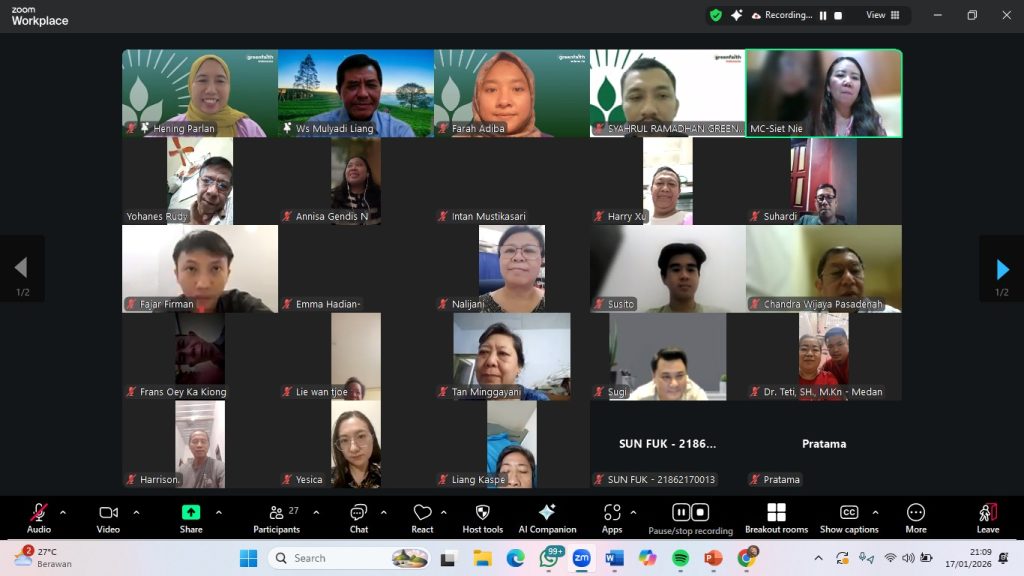
Screenshot of a group photo at the end of the Public Lecture titled “Promoting Interfaith Ecotheology Studies – Confucian Higher Education Institutions” held on Saturday, January 17, 2026.
Purwokerto, January 17, 2026 — Humans bear a moral responsibility to maintain a harmonious relationship with one another and with nature. This responsibility calls for the active involvement of religious leaders, academics, and the wider community in upholding ethical and spiritual values that sustain life on Earth.
This message was delivered by the Chairperson of the Indonesian Confucian Higher Education Institute (Sekolah Tinggi Agama Khonghucu Indonesia/STIKIN) Purwokerto, Yesica Cukarestu, S.Pd., MTCSOL, during a Public Lecture entitled “Promoting Interfaith Ecotheology Studies – Confucian Higher Education Institutions” on Saturday (January 17, 2026).
The online public lecture was organized by GreenFaith Indonesia in collaboration with STIKIN Purwokerto and was attended by 31 participants from the academic community as well as observers of interfaith and environmental issues.
In her opening remarks, Yesica emphasized that interfaith dialogue and cooperation create opportunities for collaboration among religious communities that not only contribute to environmental protection but also strengthen social cohesion amid Indonesia’s diversity. “Academic forums such as this public lecture are highly relevant and meaningful steps in responding to today’s ecological crisis,” said Yesica.
She also highlighted the strategic role of higher education institutions—not only in producing academically excellent graduates, but also in shaping individuals with strong ethical and spiritual character who care deeply about the environment. “Universities must serve as productive spaces for the exchange of ideas, fostering deeper understanding of environmental issues while encouraging concrete actions that bring real benefits,” she added.
Meanwhile, Ws Mulyadi Liang, M.Ag, a lecturer at STIKIN Purwokerto, presented ecotheology from a Confucian perspective. He explained that when sacred teachings are fully embodied, they guide humans to live in harmony with nature as part of the Sacred Way.
In Confucian thought, humans and nature form an integrated and inseparable unity. “The Earth is regarded as a mother who gives life, while the sky is the father. The universe is a manifestation of Tian’s supreme power. Therefore, harming nature means opposing the will of God,” he explained.
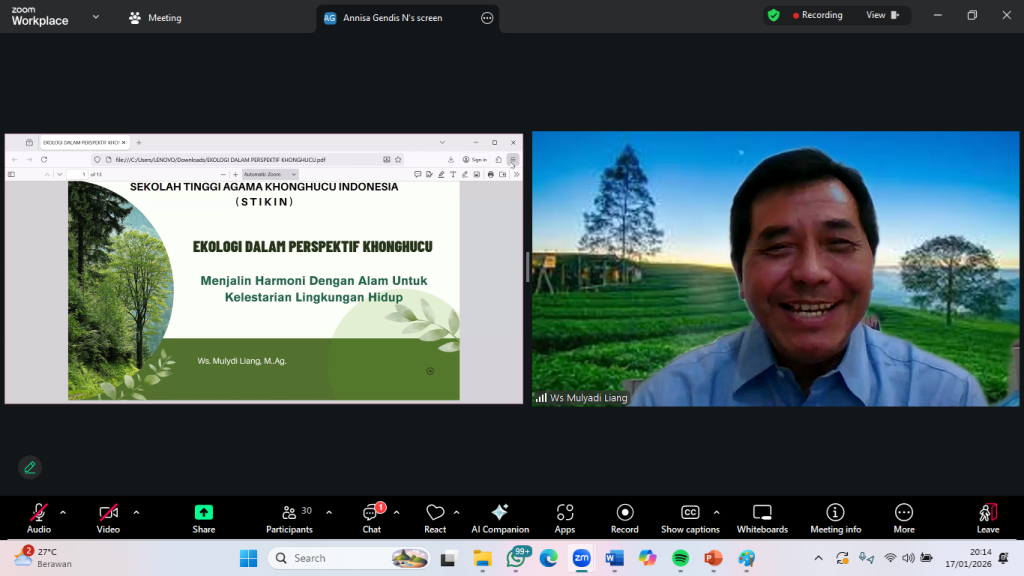
Screenshot of Ws Mulyadi Liang, M.Ag, a lecturer at STIKIN Purwokerto, presenting ecotheology from a Confucian perspective during the Public Lecture titled “Promoting Interfaith Ecotheology Studies – Confucian Higher Education Institutions” on Saturday, January 17, 2026.
He added that the core pillars of Confucian ecotheology emphasize virtues that protect and nurture life. The principle of the middle way serves as an important guide in ecological practice, such as consuming in moderation, avoiding greed, and using natural resources wisely while preserving them. According to him, this awareness must be translated into concrete actions through collaboration among religious institutions, including tree-planting activities in campus environments.
National Coordinator of GreenFaith Indonesia, Hening Parlan, explained that ecotheology is rooted in the understanding that faith and the environment are inseparable. Religious teachings fundamentally regulate three interconnected relationships: the relationship between humans and God, among humans themselves, and between humans and nature.
“All human life depends on nature. What we eat and what we use in worship all come from nature. Therefore, building spirituality between humans and the Earth must be grounded in compassion, so that this relationship is not distant or exploitative,” said Hening.
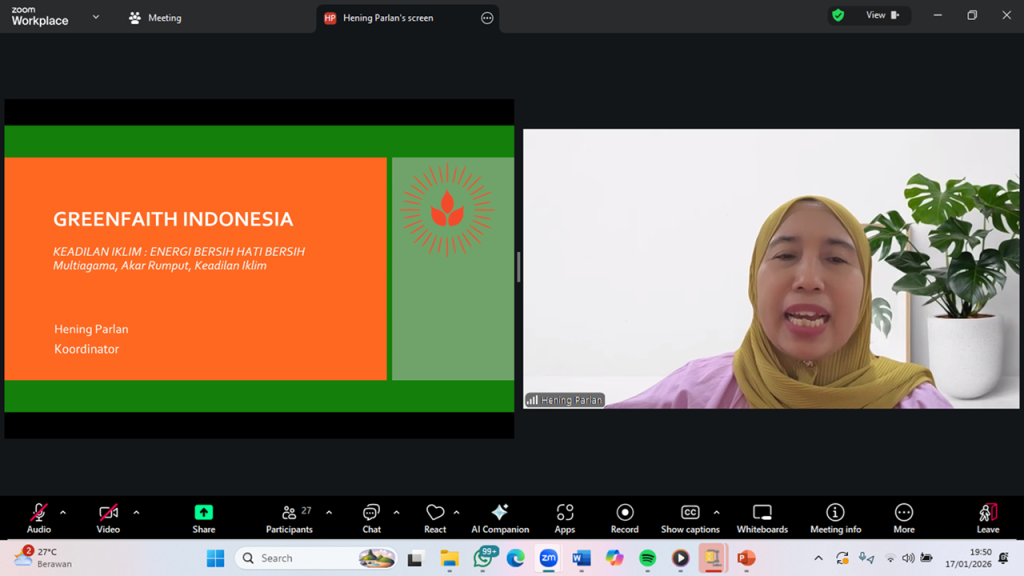
Screenshot of Hening Parlan, National Coordinator of GreenFaith Indonesia, explaining that ecotheology is rooted in the understanding that faith and the environment are inseparable during the Public Lecture titled “Promoting Interfaith Ecotheology Studies – Confucian Higher Education Institutions” on Saturday, January 17, 2026.
She highlighted the significant potential role of religion in driving change. Around 84 percent of the world’s population has a religious affiliation, and the 2023 SDGs Report notes that collaboration among faith groups plays an important role in sustainable development. One concrete example is the Faith Pavilion initiated at COP28 in Dubai, which involved around 80 interfaith religious organizations, including opportunities for contributions from Confucian communities.
Furthermore, Hening underscored the strategic role of higher education institutions in strengthening the ecotheology movement through research and community engagement. Universities can identify local environmental challenges, develop research as new knowledge, and implement it through impactful community service, in line with the Tri Dharma Perguruan Tinggi (Three Pillars of Higher Education).
Through this public lecture, GreenFaith Indonesia and STIKIN Purwokerto hope that interfaith ecotheology studies—particularly within Confucian higher education institutions—will continue to grow and inspire concrete actions to care for the Earth as part of an intergenerational spiritual and moral responsibility.